- PH: +91 8828443924
- Email: Response@ShrinithaFurnace.Com

Industrial and Laboratory Vacuum Oven Manufacturer in India
Industrial and Laboratory Vacuum Ovens – Ambient Temperature to 600°C
Shrinitha Scientific Company is an Indian manufacturer and exporter of Industrial and Laboratory Vacuum Ovens designed for controlled heating, vacuum drying, moisture removal, and specialised thermal processing. With an operating temperature range from ambient temperature up to 600°C, our vacuum oven solutions can be configured for diverse requirements in industrial facilities, research laboratories, material testing centres, and manufacturing environments.
Vacuum ovens are particularly useful for applications where materials need to be heated or dried under reduced pressure. Depending on the material and process, reduced pressure can support moisture removal at lower temperatures than conventional atmospheric drying and may help limit unwanted oxidation or other atmospheric effects.
Shrinitha Scientific Company focuses on application-based equipment selection, considering the required temperature, vacuum level, chamber dimensions, load characteristics, and process conditions to identify a suitable oven configuration.
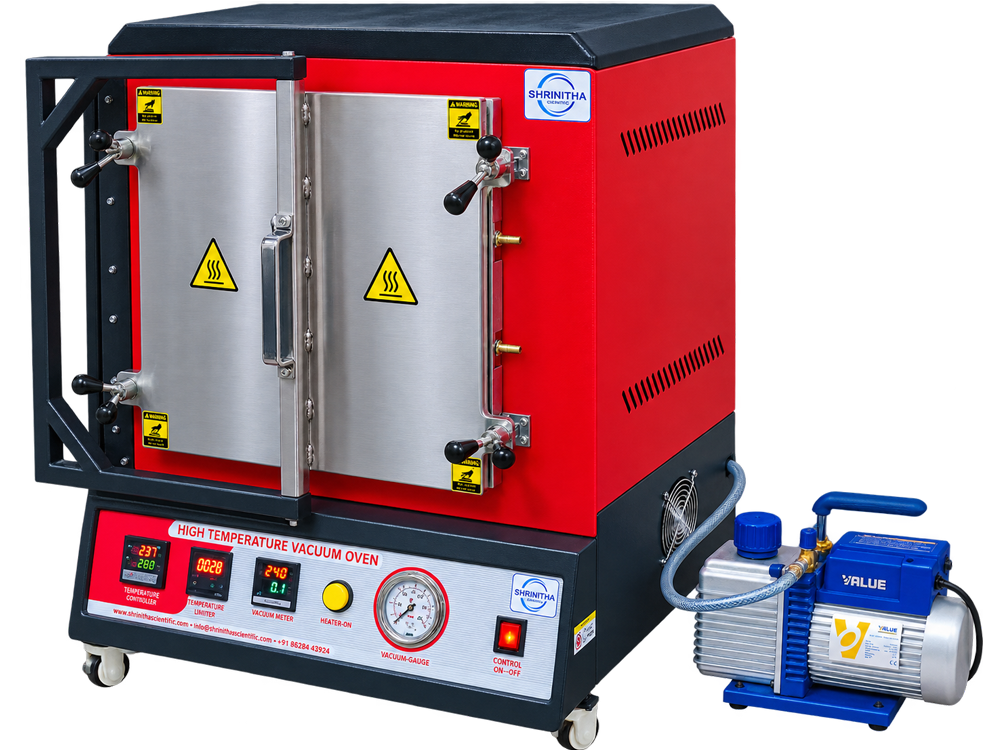
What Is a Vacuum Oven?
An Industrial and Laboratory Vacuum Oven is a specialised heating chamber designed to process materials under reduced internal pressure. The chamber is sealed, a vacuum system lowers the pressure, and a controlled heating arrangement brings the material to the required process temperature.
Reducing pressure can lower the boiling point of liquids, helping moisture and certain volatile substances evaporate under suitable conditions. This makes vacuum ovens useful for drying sensitive materials, removing residual moisture, conditioning components, and carrying out selected thermal processes.
Laboratory vacuum ovens are commonly used for sample preparation, experimentation, and material evaluation. Industrial configurations can be designed around larger components, production batches, or specialised processing requirements.
Shrinitha Scientific Company offers Industrial and Laboratory Vacuum Ovens with a stated temperature capability from ambient temperature up to 600°C. The maximum usable temperature under vacuum depends on the model's rated design, chamber materials, sealing system, vacuum conditions, and process requirements.
High Temperature Vacuum Oven Rectangular 500°C
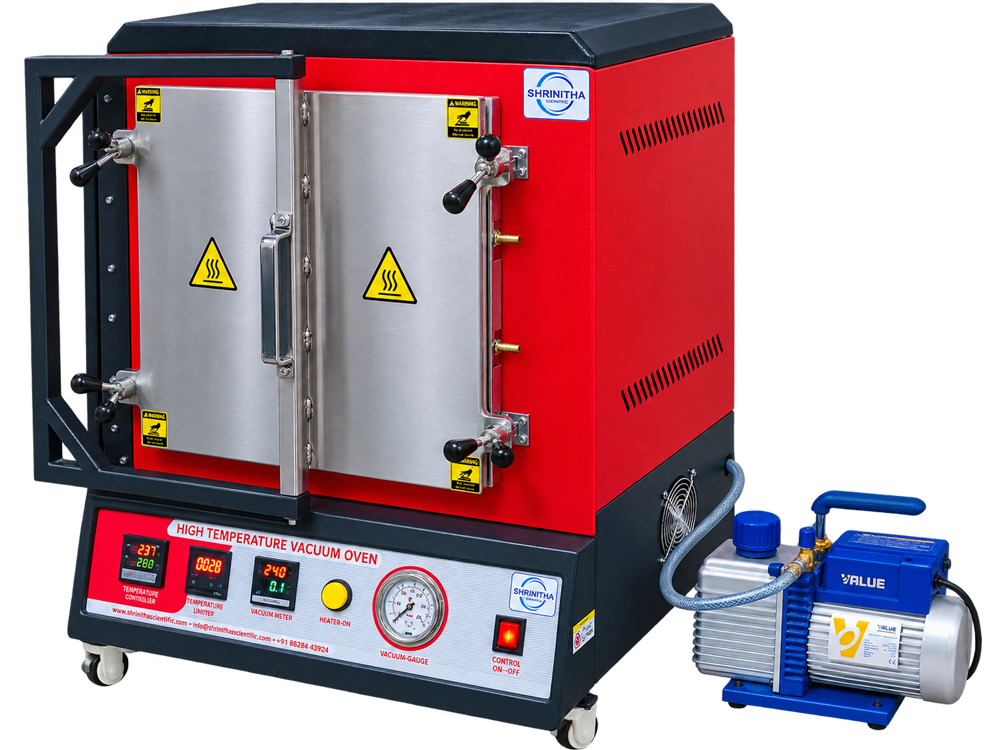
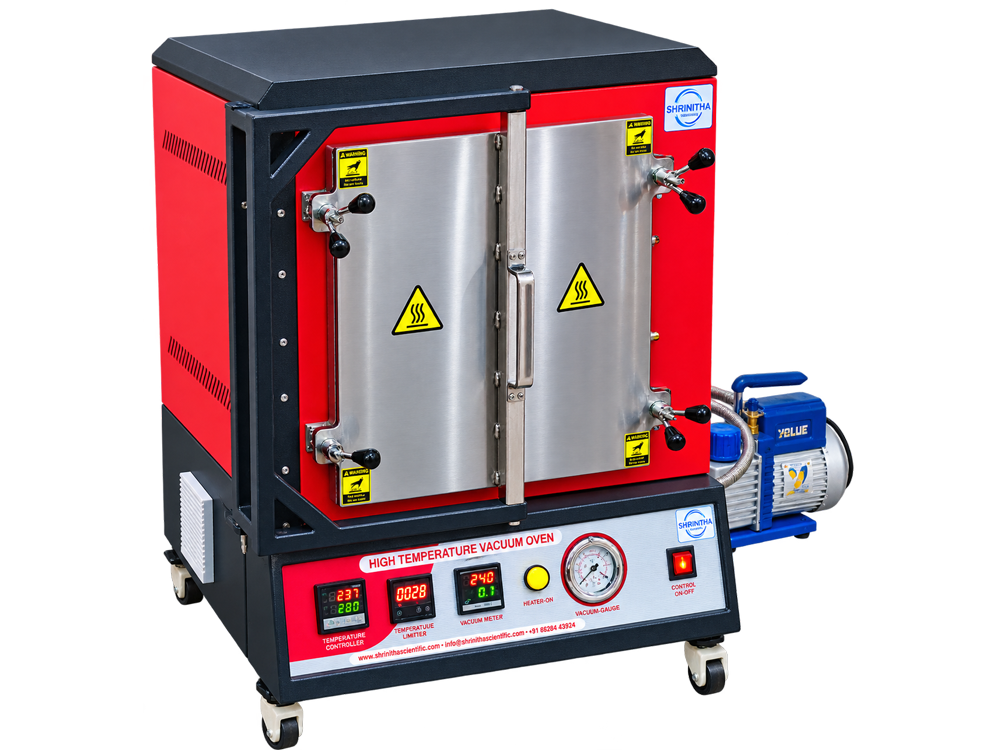
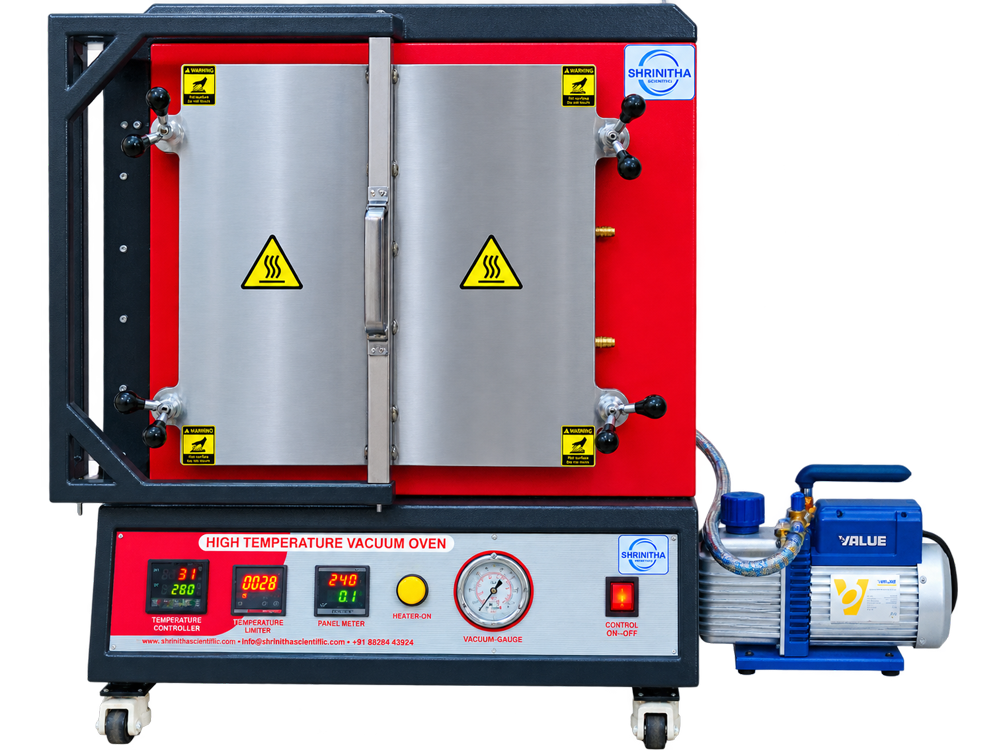
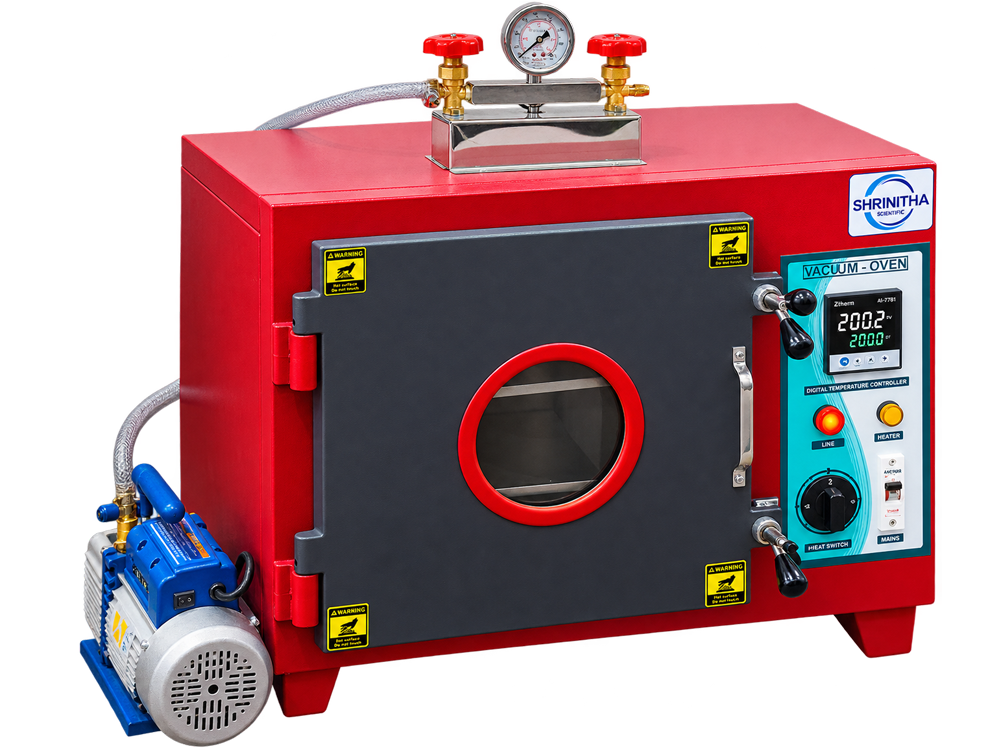
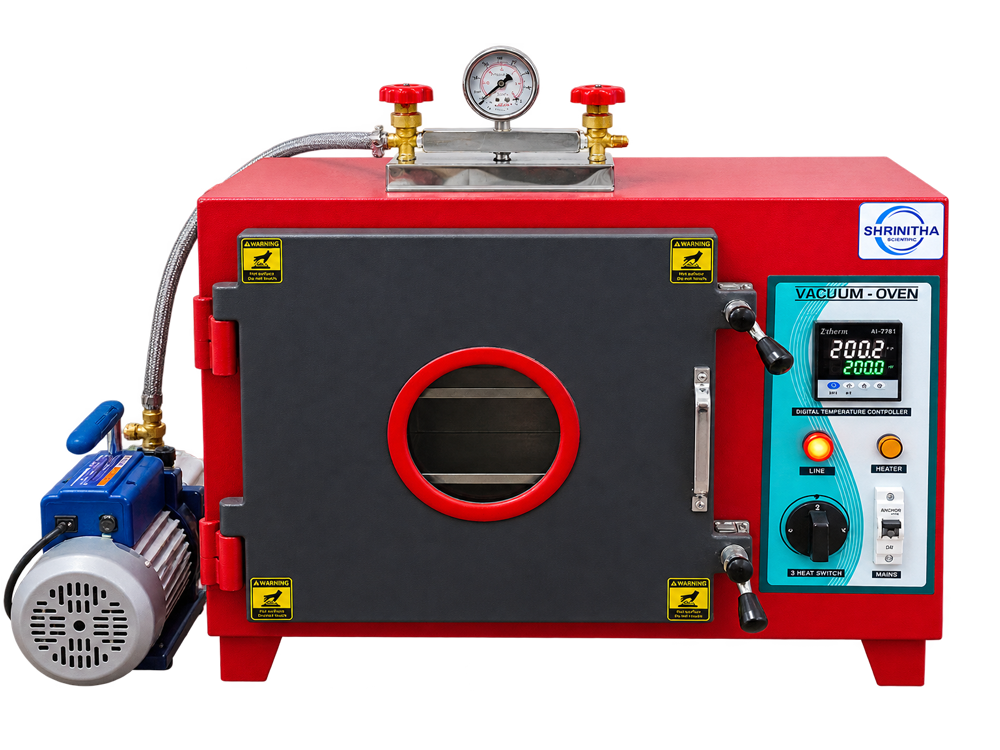
Vacuum Oven Rectangular 300°C
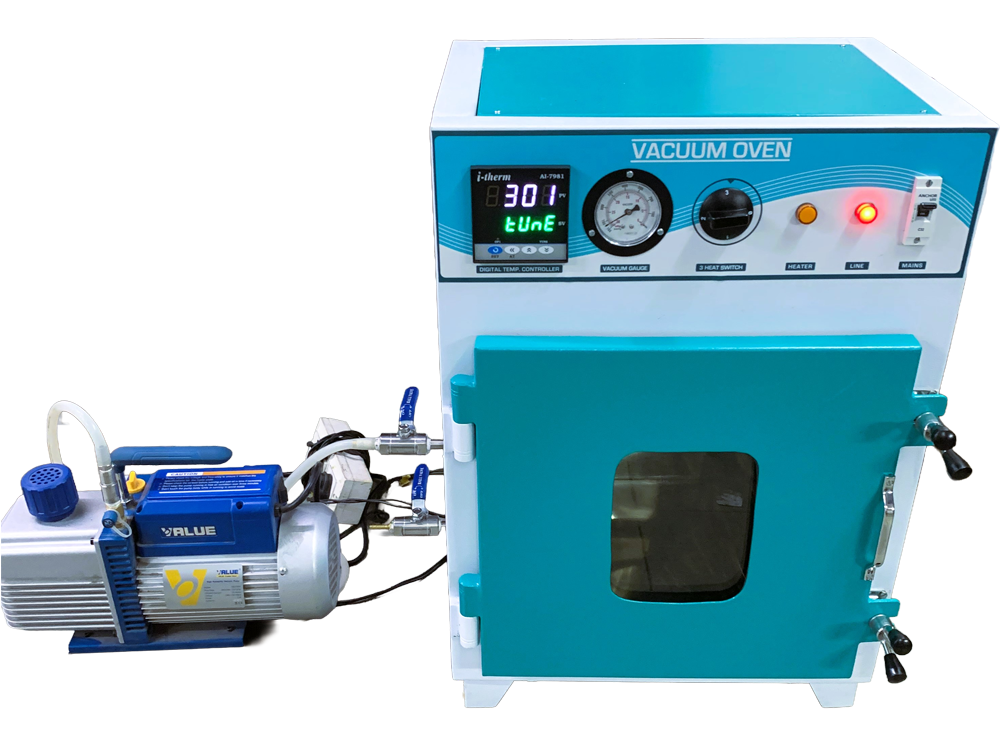
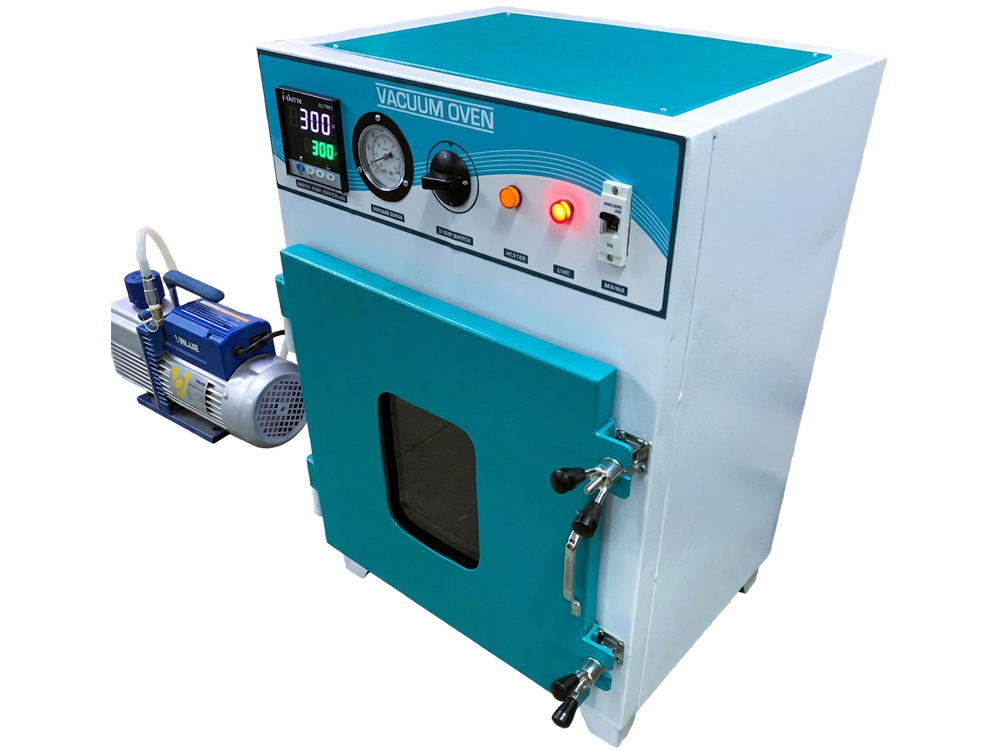
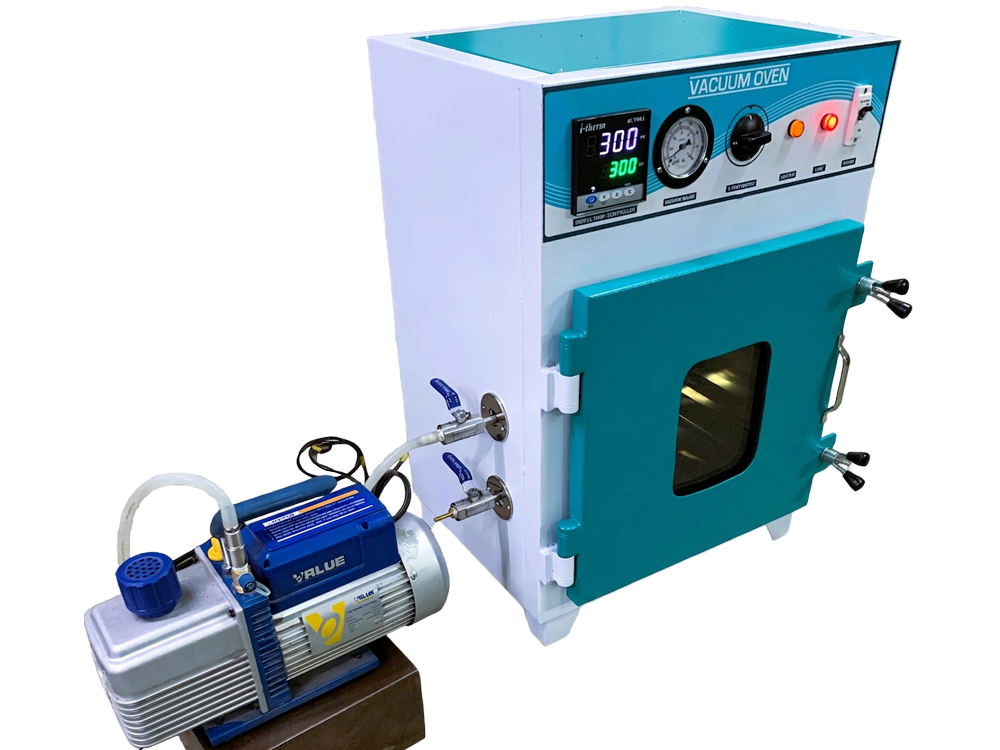
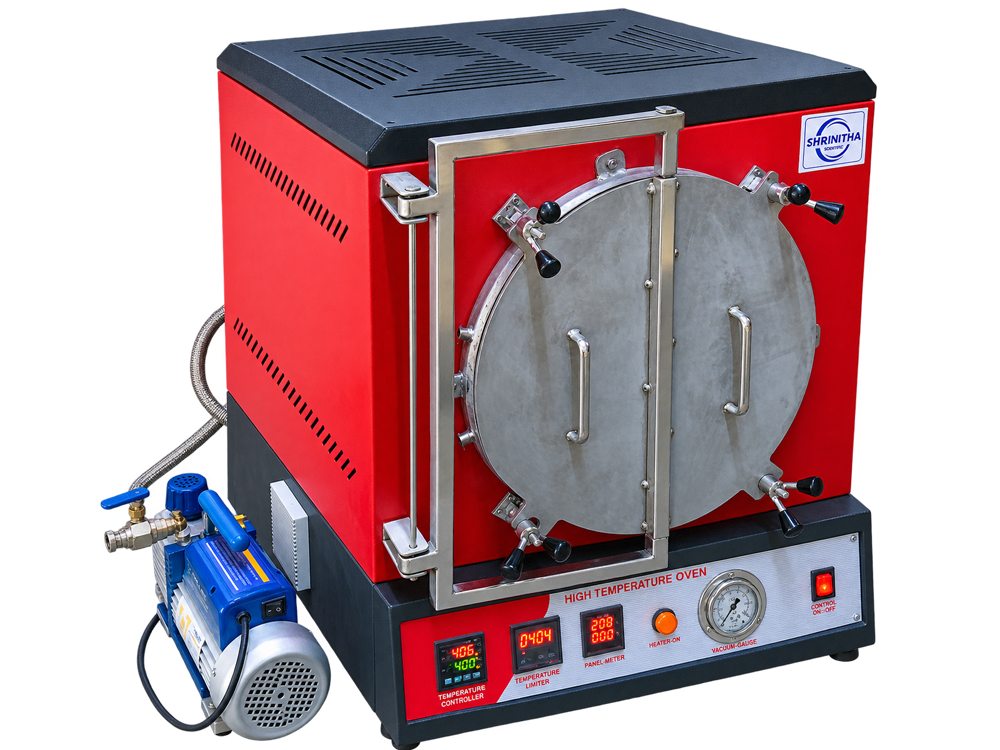
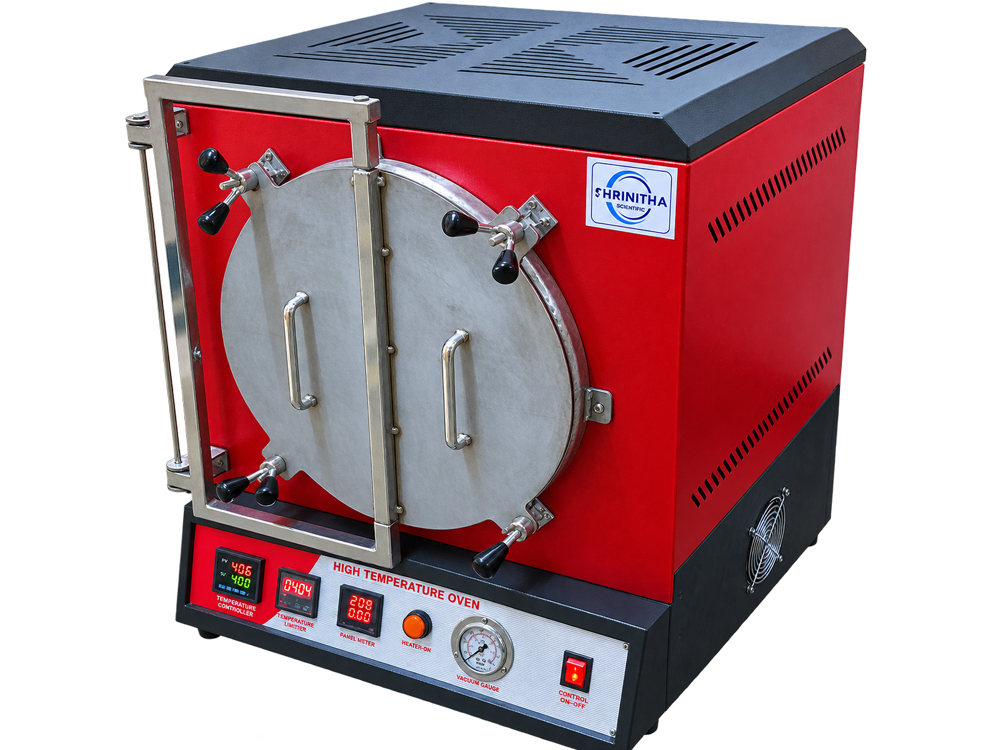
High Temperature Vacuum Oven Round 500°C
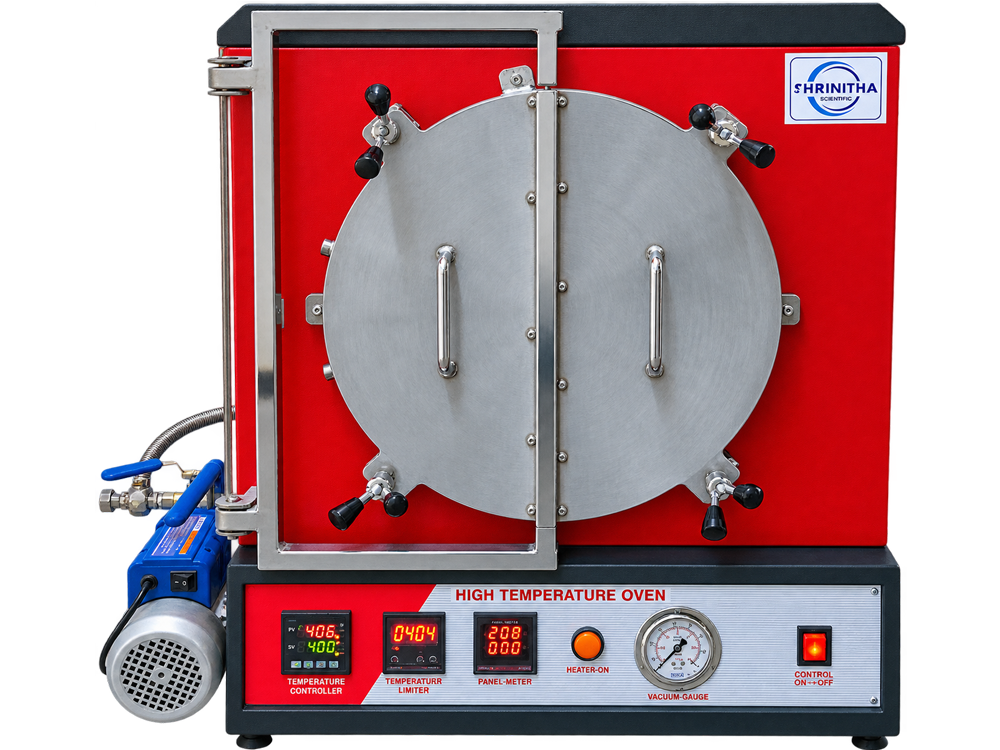
Vacuum Oven Round 250°C
Key Features of Shrinitha Scientific Vacuum Ovens
- 1. Wide Temperature Capability
Configurations designed for operating temperatures from ambient conditions up to 600°C. - 2. Reduced-Pressure Processing
A vacuum connection and compatible pumping system support processing under reduced pressure. - 3. Controlled Heating
A suitable temperature control arrangement helps regulate the heating cycle. - 4. Sealed Working Chamber
The chamber and sealing arrangement are selected to support the specified vacuum conditions. - 5. Application-Specific Construction
Chamber materials and internal components can be selected according to operating temperature and material compatibility. - 6. Vacuum Monitoring
A suitable pressure or vacuum gauge can be incorporated to monitor chamber conditions. - 7. Flexible Chamber Capacity
Dimensions and loading arrangements can be planned according to sample or component size. - 8. Laboratory and Industrial Applications
Configurations can be assessed for research, testing, manufacturing, and selected production processes. - 9. Process-Based Configuration
Vacuum level, temperature, heating method, and accessories can be considered together during equipment selection.
The availability of specific features, vacuum performance, and temperature capability depends on the final model and configuration.
Technical Specifications of Vacuum Ovens
| Parameter | Specification |
|---|---|
| Product Name | Industrial and Laboratory Vacuum Oven |
| Manufacturer | Shrinitha Scientific Company |
| Country of Origin | India |
| Temperature Range | Ambient temperature to 600°C |
| Operating Environment | Reduced pressure, according to model rating |
| Heating Method | Electrically heated |
| Temperature Control | As per model and application |
| Vacuum System | Compatible vacuum pump and connection, as specified |
| Vacuum Monitoring | Analog or digital gauge, depending on configuration |
| Working Chamber | Material selected according to temperature and vacuum requirements |
| Chamber Capacity | As per model or application |
| Chamber Dimensions | Customisable or model-dependent |
| Door and Sealing System | Designed according to the required operating conditions |
| Internal Loading Arrangement | Shelves, trays, or other suitable arrangements as specified |
| Electrical Supply | According to heater rating and model |
| Optional Process Features | To be confirmed according to application |
| Primary Applications | Vacuum drying, moisture removal, material conditioning, and selected thermal processes |
Important specification note: This is a general specification overview, not a confirmed model datasheet. The maximum operating temperature, vacuum level, chamber capacity, temperature uniformity, control accuracy, pump capacity, and construction materials should be confirmed for the particular oven before purchase.
Working Principle of Vacuum Oven
The working principle of a vacuum oven combines controlled heating with pressure reduction. The vacuum system lowers the pressure inside the sealed chamber, while the heating system supplies energy to the material being processed.
Step 1: Loading the Material
The samples, components, or materials are placed inside the chamber using the designated shelves, trays, or loading arrangement. The material must be compatible with the intended temperature and vacuum conditions.
Step 2: Sealing the Chamber
The door is closed and secured so the chamber can maintain the required reduced pressure during operation.
Step 3: Creating Vacuum Conditions
A compatible vacuum pump removes gases from the chamber and reduces the internal pressure to the selected operating level.
Step 4: Applying Controlled Heat
The heating system raises the temperature according to the selected process settings. Heat reaches the load through the oven's designed heat-transfer arrangement.
Step 5: Moisture or Volatile Removal
Under reduced pressure, moisture and certain volatile substances may evaporate at lower temperatures than they would under atmospheric conditions. The actual drying rate depends on the material, its thickness, moisture content, temperature, pressure, and load arrangement.
Step 6: Monitoring the Process
Temperature and vacuum conditions are monitored using the instruments provided with the selected configuration. The process is continued for the duration established by the application requirements.
Step 7: Controlled Completion and Unloading
At the end of the cycle, the equipment is brought to a suitable condition before the chamber is returned to atmospheric pressure and opened. The operating procedure must account for material temperature, residual vapours, and any process-specific hazards.
Types of Vacuum Ovens
Shrinitha Scientific Company can help determine an appropriate vacuum oven configuration based on the material, required temperature, pressure conditions, chamber capacity, and intended process.
1. Laboratory Vacuum Oven
Designed for laboratory sample preparation, controlled drying, research activities, and material testing. Capacity and instrumentation are selected according to the laboratory's requirements.
2. Industrial Vacuum Oven
Intended for processing components, materials, and batches in industrial environments. Chamber dimensions, heating capacity, vacuum system, and loading arrangements depend on the production process.
3. High-Temperature Vacuum Oven
Designed for specialised applications that require elevated temperatures. For models intended to operate up to 600°C, the chamber, seals, sensors, heaters, and other components must be rated for the actual operating conditions.
4. Vacuum Drying Oven
Used for removing moisture or suitable volatile substances from compatible materials under reduced pressure. The required vacuum and temperature depend on the material and target moisture level.
5. Vacuum Heat-Processing Oven
Configured for selected heating and conditioning processes in which a reduced-pressure environment is beneficial. Suitability depends on the material, process chemistry, and oven design.
6. Customised Vacuum Oven
A configuration developed around specific requirements such as chamber dimensions, load geometry, temperature range, vacuum level, pump arrangement, and monitoring needs.
These descriptions represent possible application-based configurations. Confirm the actual models and available options directly with Shrinitha Scientific Company.
Applications of Vacuum Ovens
Research and Development Laboratories
- Controlled drying of compatible research samples.
- Preparation of specimens for analytical testing.
- Investigation of material behaviour under reduced pressure and heat.
- Experimental evaluation of moisture removal and thermal conditioning.
Pharmaceutical and Chemical Research
- Drying suitable laboratory materials and intermediates.
- Removing residual moisture from compatible samples.
- Supporting research procedures involving temperature-sensitive substances.
- Processing selected materials where reduced pressure is required.
Materials that release hazardous, corrosive, flammable, or reactive vapours require a specifically assessed system and suitable operating controls. Not every chemical process is appropriate for a standard vacuum oven.
Electronics and Electrical Manufacturing
- Moisture removal from compatible components.
- Drying selected parts before assembly or further processing.
- Thermal conditioning of components where the required temperature and vacuum conditions are suitable.
Materials Science and Engineering
- Preparing material specimens for laboratory evaluation.
- Drying porous or moisture-bearing samples.
- Studying selected material responses to controlled thermal conditions.
- Conditioning materials before subsequent testing.
Industrial Manufacturing
- Drying compatible manufactured components.
- Processing selected materials under reduced pressure.
- Removing residual moisture from suitable parts.
- Supporting specialised production processes where vacuum heating is appropriate.
Quality Control and Testing Laboratories
- Preparing samples for repeatable testing procedures.
- Conducting controlled drying cycles.
- Evaluating moisture-related changes in compatible materials.
- Supporting process development and quality assessment.
Specialised Thermal Processing
Vacuum ovens rated for elevated temperatures may support selected high-temperature processes. The intended application must be reviewed to ensure the oven's pressure rating, temperature capability, heating arrangement, and materials are appropriate.
Advantages of Industrial and Laboratory Vacuum Ovens
- 1. Drying Under Reduced PressureThe reduced-pressure environment can help moisture evaporate at temperatures lower than those required under atmospheric conditions, depending on the material and process.
- 2. Support for Temperature-Sensitive MaterialsWhen a suitable process has been established, vacuum drying may reduce the thermal exposure needed for moisture removal from certain sensitive materials.
- 3. Reduced Exposure to Atmospheric OxygenRemoving air from the chamber can reduce oxygen exposure during processing. The actual protection against oxidation depends on the residual atmosphere, leakage, temperature, and material chemistry; vacuum alone does not guarantee an oxygen-free environment.
- 4. Adaptability Across ApplicationsDifferent chamber sizes, temperature ratings, and vacuum arrangements can support varied laboratory and industrial requirements.
- 5. Controlled Process ConditionsTemperature and pressure monitoring help operators manage the process according to defined operating parameters.
- 6. Support for Material PreparationVacuum ovens can be used to prepare compatible samples and components for subsequent testing, assembly, or processing.
- 7. Potential for Lower-Temperature Moisture RemovalFor suitable materials, reduced pressure can make it possible to remove moisture without relying solely on high atmospheric-pressure temperatures.
- 8. Application-Based ConfigurationSelecting the chamber, vacuum system, temperature rating, and controls for the intended process helps avoid an unsuitable one-size-fits-all design.
Vacuum Oven vs. Conventional Hot Air Oven
| Comparison Point | Vacuum Oven | Conventional Hot Air Oven |
|---|---|---|
| Operating Environment | Reduced pressure when vacuum is applied | Generally atmospheric pressure |
| Primary Heating Purpose | Heating and drying under vacuum conditions | Heating and drying using heated air |
| Moisture Removal | Reduced pressure may lower the evaporation temperature | Depends on temperature, airflow, and material properties |
| Oxygen Exposure | Can be reduced by evacuating air, but not necessarily eliminated | Material is generally exposed to air |
| Vacuum Pump | Required for vacuum operation | Not normally required |
| Typical Selection Consideration | Useful when pressure reduction is important to the process | Useful for compatible processes that can be performed in air |
The appropriate equipment depends on the material and process. A vacuum oven is not automatically better for every drying application; conventional ovens may be more suitable for materials that do not require reduced-pressure processing.
Why Choose Shrinitha Scientific Company?
Shrinitha Scientific Company is an Indian manufacturer and exporter of industrial and laboratory heating equipment. We understand that vacuum processing requirements can vary significantly according to the material, target temperature, required pressure, and intended production or laboratory use.
Reasons to consider Shrinitha Scientific Company include:
- Industrial and Laboratory Equipment: Solutions for scientific research, testing, and manufacturing environments.
- Temperature Capability up to 600°C: Configurations can be evaluated for applications requiring elevated operating temperatures.
- Application-Oriented Selection: Consideration of material characteristics, required vacuum, process duration, and load dimensions.
- Configurable Chamber Design: Chamber capacity and loading requirements can be discussed during equipment selection.
- Manufacturing and Export Services: Support for customers seeking industrial and laboratory vacuum ovens.
- Technical Requirement Assessment: Assistance in identifying key specifications for the intended process.
For an appropriate recommendation, provide the required operating temperature, target vacuum level, chamber dimensions, material details, batch quantity, and process duration.
Frequently Asked Questions (FAQs)
Q1. What is an Industrial and Laboratory Vacuum Oven used for?
A vacuum oven is used for heating and drying compatible materials under reduced pressure. Typical applications include moisture removal, sample preparation, material conditioning, and selected industrial thermal processes.
Q2. What is the maximum temperature of Shrinitha Scientific Vacuum Ovens?
The stated temperature range is from ambient temperature up to 600°C. Confirm the maximum rated temperature under the required vacuum conditions for the specific model.
Q3. How does a vacuum oven remove moisture?
A vacuum pump lowers the pressure inside the sealed chamber. This can reduce the boiling point of liquids, allowing moisture to evaporate under suitable heating conditions.
Q4. Can vacuum ovens be used for heat-sensitive materials?
They can be suitable for certain heat-sensitive materials because reduced pressure may allow drying at lower temperatures. The material must still be assessed for thermal stability, chemical compatibility, and vacuum suitability.
Q5. Is a vacuum pump required?
Yes, a suitable vacuum pump or vacuum system is required to create and maintain reduced pressure during vacuum operation. Pump selection depends on the chamber volume, target pressure, vapour load, and required evacuation time.
Q6. Can vacuum ovens be used in industrial manufacturing?
Yes. Industrial configurations may be used for drying components, conditioning materials, and specialised processing where reduced pressure is beneficial. The design should match the actual production requirements.
Q7. What is the difference between a vacuum oven and a hot air oven?
A vacuum oven processes materials under reduced pressure, while a conventional hot air oven generally operates at atmospheric pressure using heated air. The choice depends on the required drying conditions and material sensitivity.
Q8. Does a higher temperature guarantee faster drying?
No. Drying performance also depends on pressure, material composition, moisture content, sample geometry, heat transfer, and vapour removal. The process parameters must be established for the specific material.
Q9. Can a vacuum oven operate at 600°C?
Only a model specifically designed and rated for the required temperature and vacuum conditions should be used at 600°C. Confirm the complete operating envelope with the manufacturer.
Q10. What details should I provide when requesting a quotation?
Provide the required temperature, target vacuum level, chamber size, material type, load weight, batch quantity, process duration, vapour characteristics, and electrical supply details. These details help determine the appropriate configuration.
Enquire About Industrial and Laboratory Vacuum Ovens
Looking for an Industrial or Laboratory Vacuum Oven for research, testing, or manufacturing applications? Shrinitha Scientific Company can help you evaluate a suitable configuration based on your temperature, vacuum, chamber capacity, and material-processing requirements.
Contact us with your application details to discuss technical specifications, available configurations, and pricing.
Shrinitha Scientific Company – Vacuum Oven Solutions for Controlled Heating and Reduced-Pressure Processing.